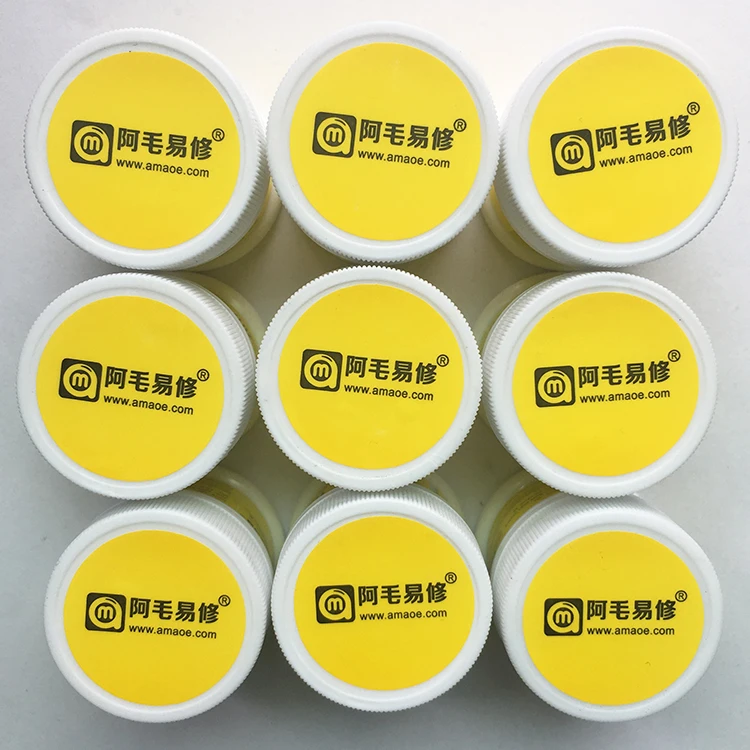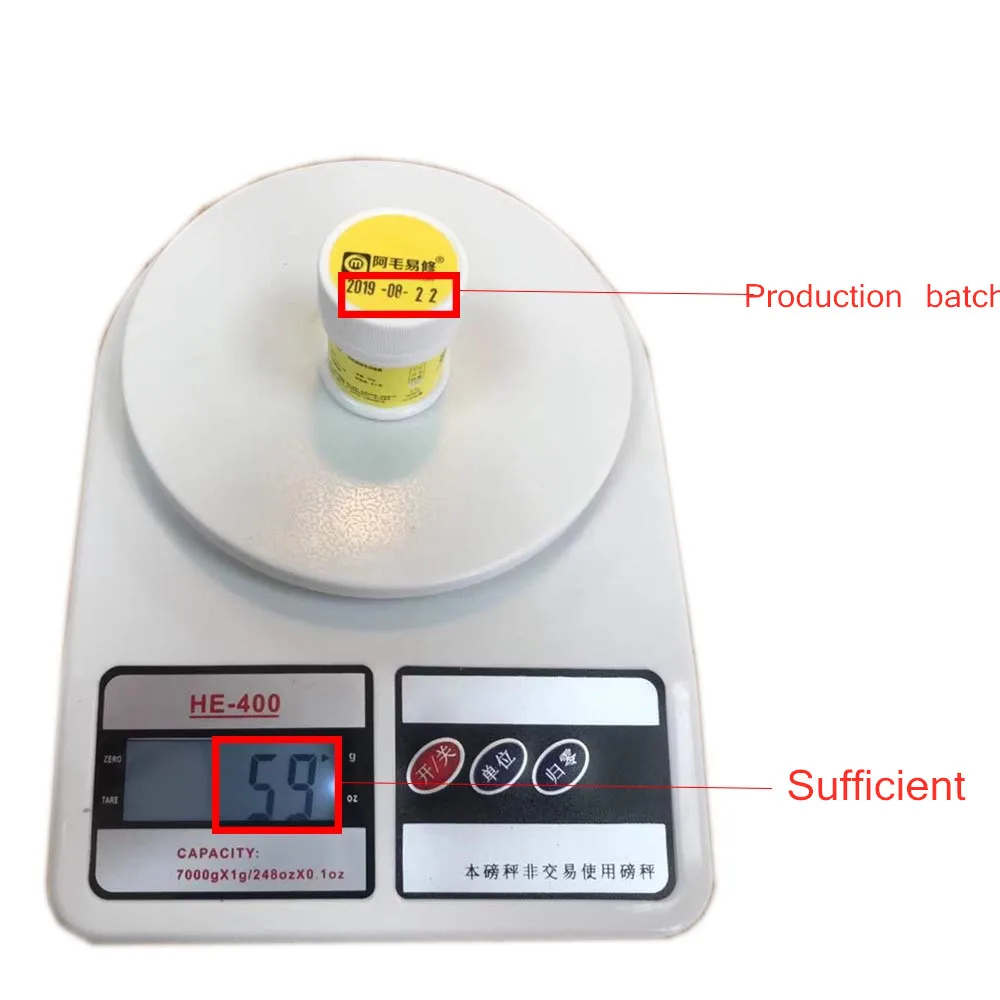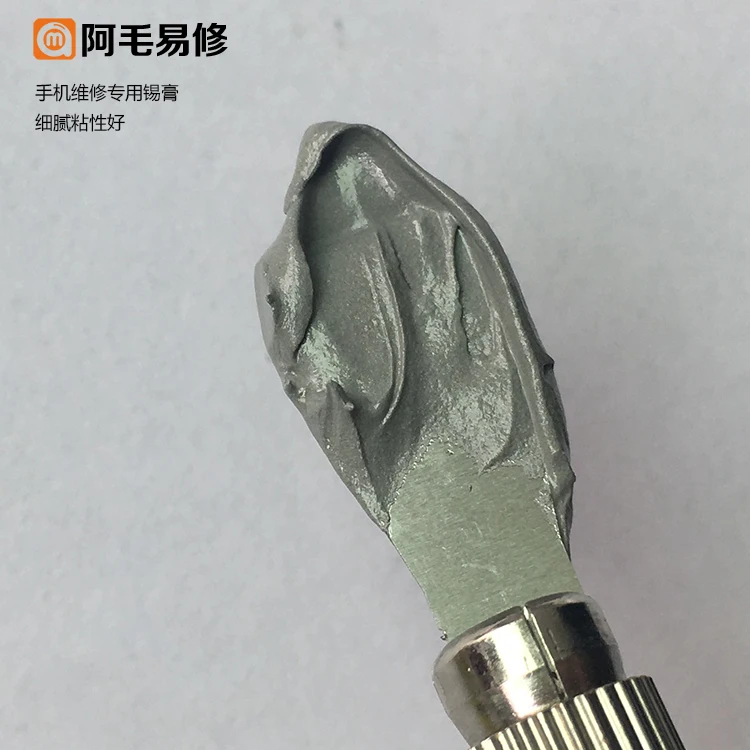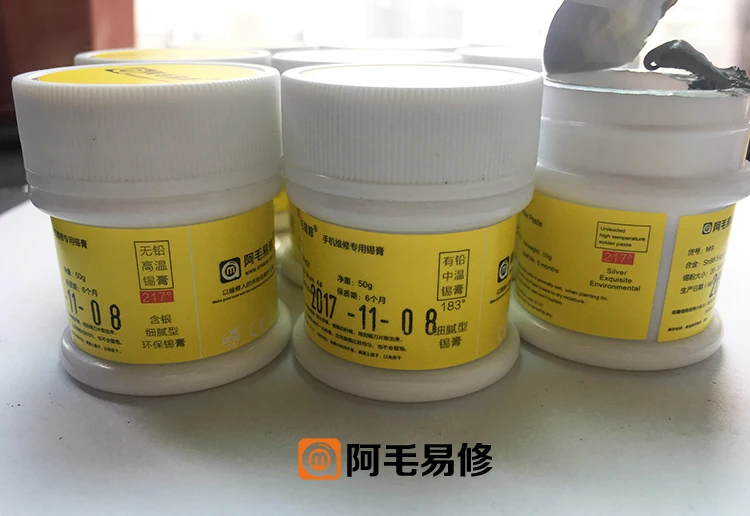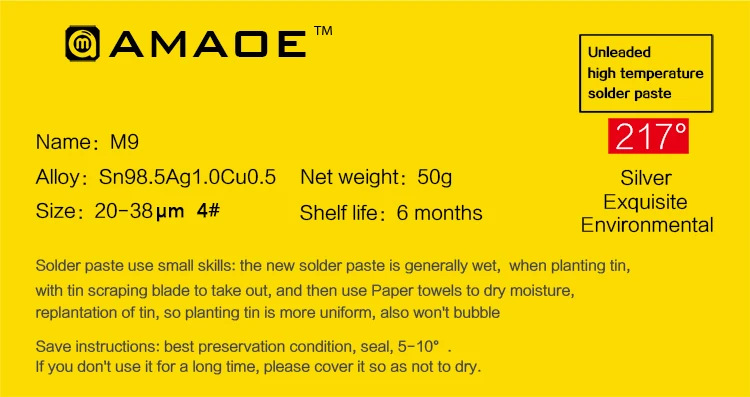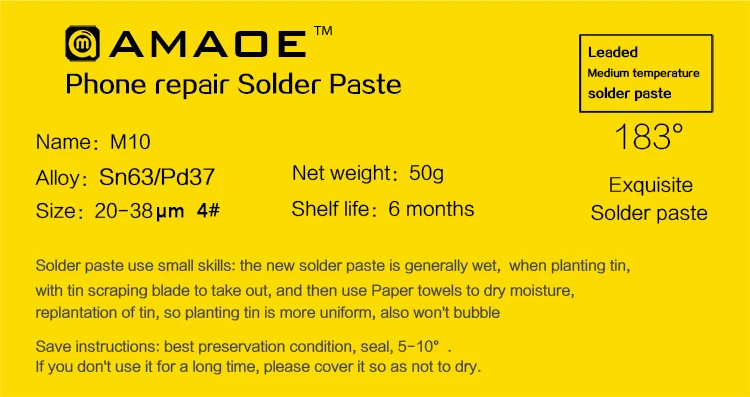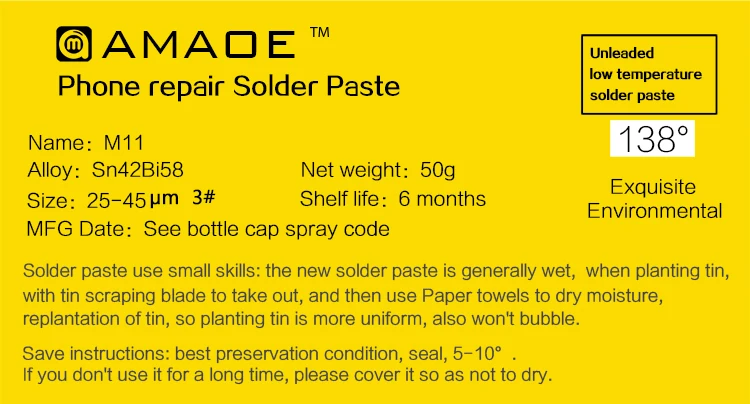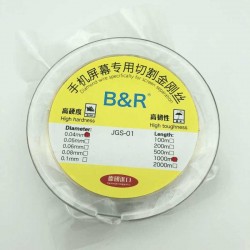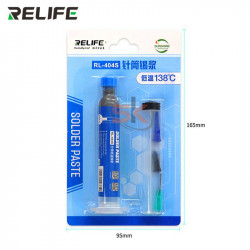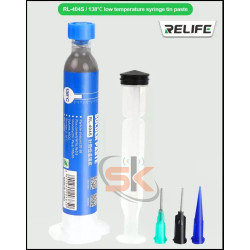

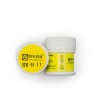




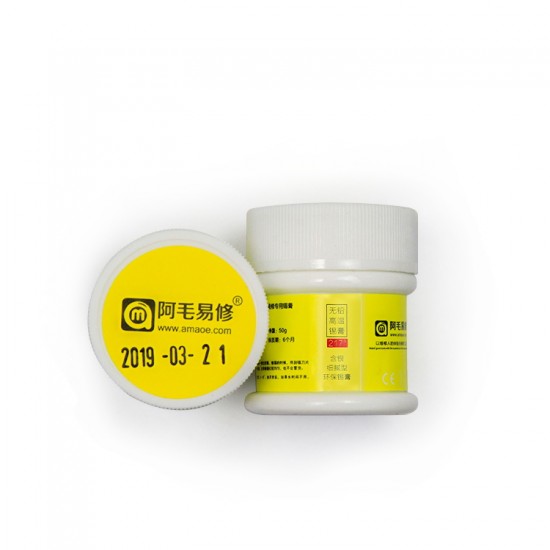

The Amaoe M9 (217°C) High-Temperature Lead-Free Solder Flux Paste is an industrial-grade micro-soldering alloy formulated for master technicians demanding OEM factory-standard solder joints, full environmental compliance, and maximum mechanical shear resistance on smartphone motherboards. Formulated with a refined silver-bearing lead-free alloy matrix (Sn99/Ag0.3/Cu0.7 / SAC profile) and advanced high-activity, no-clean rosin flux carriers, M9 liquefies cleanly at 217°C (422.6°F), replicating original factory SMT production standards.
While higher melting temperatures require disciplined heat management and micro-soldering experience, Amaoe M9 rewards technicians with unmatched joint durability. Solder joints produced with M9 resist physical drop impact, thermal expansion fatigue, and high operating temperatures far better than standard leaded or low-temperature bismuth alloys. Its atomized spherical micro-powder flows cleanly through precision BGA stencils without foaming, tin-bead dispersion, or cold solder defects.
Key Engineering Features & Bench Advantages:
- High-Temperature 217°C OEM Standard: Matches factory lead-free reflow standards, making it the premier choice for master technicians seeking permanent, zero-compromise repairs that mimic original assembly specs.
- Silver-Enriched Lead-Free Alloy: Incorporates elemental silver (Ag) to enhance tensile bond strength, prevent intermetallic brittleness, and provide bright, uniform solder joints that withstand physical shock and device flexing.
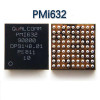
- Exceptional Creep & Thermal Fatigue Resistance: Designed for high-heat smartphone power delivery zones—such as Baseband, Power Management ICs (PMIC), and Application Processors (AP)—ensuring joints do not soften or crack under sustained chip thermal dissipation.
- Non-Boiling & Anti-Tin-Bead Flux Matrix: Formulated with an active anti-bubble organic carrier that prevents explosive flux boiling, virtually eliminating stray micro-beads around 0201/01005 passives.
- Ultra-Fine Spherical Powder Distribution: Uniform micro-particle spherical powder slides effortlessly through fine-pitch BGA stencils (0.12mm–0.15mm) without clogging mesh holes or bridging pins.
- Clean, Non-Corrosive Flux Residue: Leaves minimal, clear, non-conductive residue post-reflow that brushes away cleanly with 99% isopropyl alcohol (IPA) and an ESD brush.
Technical Specification Matrix
Parameter Profile | Product Specification Details |
Product Model | Amaoe M9 High-Temperature Solder Paste |
Alloy Composition | Sn99 / Ag0.3 / Cu0.7 (Lead-Free Silver-Enhanced SAC Alloy) |
Melting Temperature | 217°C (422.6°F) |
Particle Size Grade | Micro-Fine Precision Spherical Powder (Fine-Pitch BGA Ready) |
Flux Classification | No-Clean, High-Activity, Non-Corrosive Rosin |
Standard Net Weight | 50g Airtight Screw-Top Bench Pot |
Recommended Heating Sources | High-Power Hot Air Rework Stations, Controlled Preheating Beds |
Primary Bench Applications | Master-Level CPU Reballing, Baseband/RF Section Tinning, PMIC Replacement, High-Heat IC Mounting |
Bench Application & Reflow Guide:
- Pad Cleaning & Conditioning: Clean the target BGA pads thoroughly using a desoldering braid and flux. Remove oxidized intermetallic layers and degrease completely with 99% IPA.
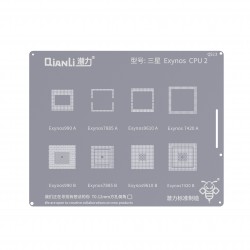
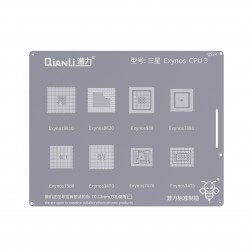
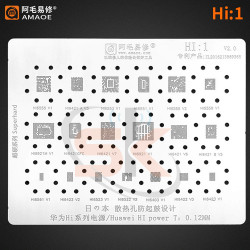
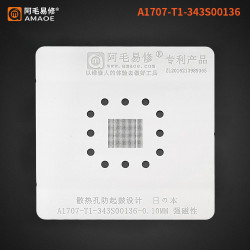
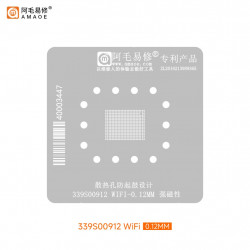
- Precision Stencil Loading: Place your specialized steel BGA stencil (e.g., Amaoe CPU or PMIC stencil) squarely over the chip. Using a flat scraping knife, apply Amaoe M9 at a 45° angle, packing each aperture flush.
- Moisture & Oil Management: Lightly dab the top of the stenciled paste with a dust-free wipe to absorb excess surface oils, preventing aperture bridging when heat is applied.
- Controlled Reflow Heating: Set your hot air rework station to 330°C–360°C with moderate airflow (30–40%). Pre-warm the entire stencil from 2.5 cm away, then lower to 1.5 cm in steady circular passes. The alloy will melt into glossy, uniform spherical balls at 217°C.
- Post-Reflow Cleanup: Allow the board or chip to cool below 100°C before releasing the stencil. Apply a dab of liquid rework flux and run a brief 3-second reflow pass for a pristine, factory-grade mirror shine. Clean any flux residue with an ESD brush and 99% IPA.