





- Stock: In Stock
- Model: HHT G7 Blade Set
- Weight: 0.05kg
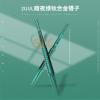
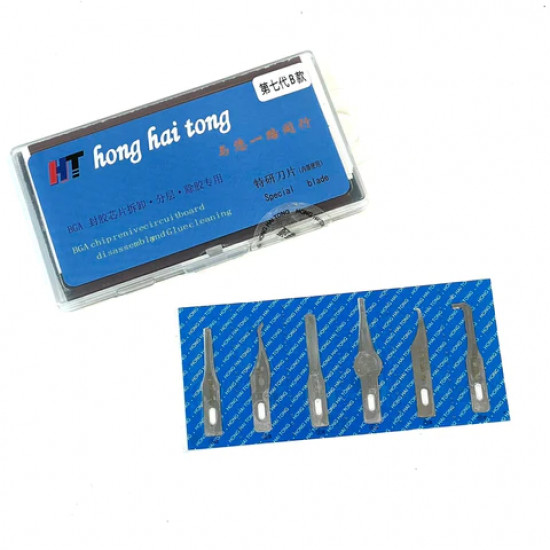
The Hong Hai Tong HHT G7 Blade Set For Removing Glue is an advanced 6-piece micro-soldering blade toolkit engineered specifically for precision BGA chip disassembly, hard epoxy underfill clearing, edge sealant trenching, and layered motherboard delamination. Manufactured from ultra-thin, high-elasticity imported spring steel, this specialized 7th-generation (G7) set provides technicians with calibrated blade contours to safely remove stubborn black and clear resin from smartphone logic boards without scratching solder masks or severing fine-pitch copper traces.
Modern multi-layer logic boards (such as iPhone A-series sandwich boards and dense Qualcomm/MediaTek Android motherboards) utilize heat-cured underfills that bond ICs firmly to the PCB laminate. Standard rigid blades or scalpels easily gouge fiberglass and rip solder pads under heat. The HHT G7 blades feature micro-thin profiles and non-abrasive polished edges that slide beneath IC packages under hot air assistance, slicing and peeling softened glue with minimal downward force.
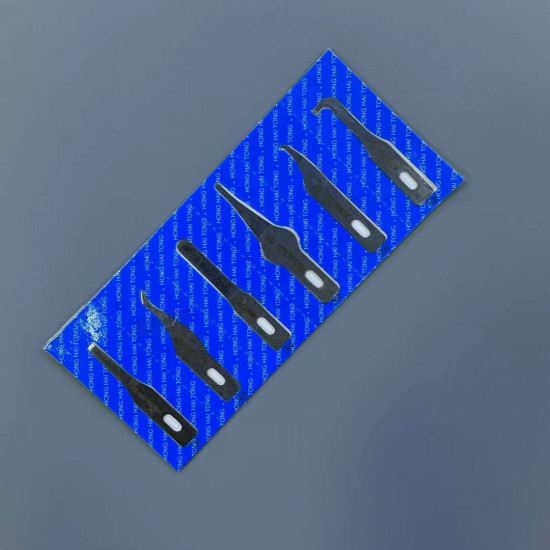
Complete 6-Piece Blade Profile Matrix:
- 1# Blade (Micro-IC & Tight Clearance): Compact, narrow-profile blade for cutting perimeter sealant around audio ICs, charging controllers, and tightly clustered SMD passives.
- 2# Blade (Surface Scraping & Large BGA): Wide flat spatula designed for skimming residual glue off large power-management ICs (PMIC) and motherboard pad arrays post-desoldering.
- 3# Blade (Sandwich Board & CPU Delamination): Ultra-thin pry blade with graduated wedge geometry, engineered for separating tiered double-decker logic boards and dual-layer CPU/RAM stacks.
- 4# Blade (Baseband & Font IC Trenching): Angled cutting profile optimized for cleaning out edge adhesive along long IC perimeters such as baseband processors and flash storage.
- 5# Blade (Curved Radius Hook Scraping): Curved hook scraper designed to rake and scoop softened adhesive out of narrow corner trenches between chips and surrounding 0201/01005 components.
- 6# Blade (NAND Flash & Wi-Fi Module Prying): Low-profile spatula tip engineered to slip cleanly under large-area NAND chips and shielded Wi-Fi modules for smooth, pad-safe chip lifting.
Key Engineering Features & Bench Advantages:
- Elastic High-Carbon Spring Steel: Blanks are stamped and finished from premium spring steel, allowing subtle lateral flex rather than digging sharply into circuit board substrates.
- Hand-Polished Non-Scratch Edges: Formulated to shear and roll away softened epoxy resin without gouging the board's protective solder mask or cutting micro jumper wires.
- Thermal Endurance Under Rework: Retains structural temper and hardness under continuous hot air temperatures ranging from 240°C to 300°C without dulling or warping.
- Universal Shank Design: Standard slotted blade tangs lock firmly into all universal micro-craft handles, brass collets, and rotary chucks (compatible with Hong Hai Tong, Mechanic, QianLi, and 2UUL handles).
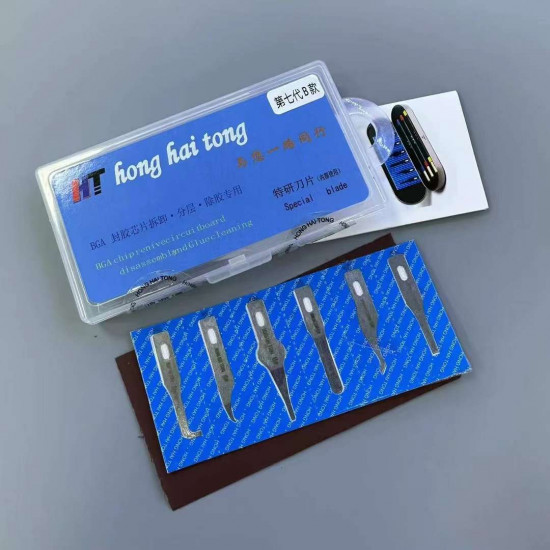
- Protective Storage Caddy: Ships in a compact, labeled caddy case that protects precision blade tips from impact and organizing them by profile number on the bench.
Technical Specification Matrix
Parameter Profile | Product Specification Details |
Product Brand | Hong Hai Tong (HHT) |
Model / Series | HHT G7 (7th Generation) Blade Set |
Kit Contents | 6x Specialized Interchangeable Blades (1# to 6#) + Protective Storage Box |
Blade Metallurgy | High-Elasticity Spring Steel / High-Carbon Alloy |
Blade Thickness | Ultra-Thin (~0.10mm – 0.12mm) |
Thermal Operating Limit | Heat-resistant up to 300°C continuous under hot air |
Handle Compatibility | Standard micro-knife collet chucks and universal craft knife handles |
Primary Applications | Phone CPU Glue Removal, Layered Board Separation, NAND Prying, Hook Trench Cleaning |
Bench Application & Usage Guide:
- Blade Mounting: Select the numbered blade required for your repair. Insert the slotted tang firmly into your micro-handle collet and tighten the locking chuck collar to prevent blade wobble.
- Thermal Softening: Set your hot air rework station to 240°C–260°C with low-to-medium airflow. Gently warm the perimeter of the target chip for 15–20 seconds to soften the epoxy underfill.
- Trenching & Perimeter Clearing: Using blade 1#, 4#, or 5#, pull the blade along the perimeter seam of the IC to clear the softened adhesive channel, isolating surrounding passive resistors and capacitors.
- Chip Lifting: Increase hot air to reflow temperature (300°C–330°C). Once the solder alloy liquefies, slide the flat tip of blade 2#, 3#, or 6# into a corner. Apply gentle upward levering to lift the IC cleanly from its pads.
- Surface Dressing: Reheat the residual glue remaining on the PCB pad array, using the flat face of blade 2# to gently scrape and roll the glue away. Finish by wiping the area with 99% IPA and an ESD brush.